

10th Armored Division
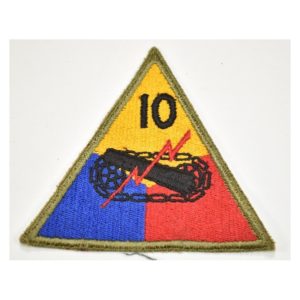
The U.S. Army's 10th Armored Division, nicknamed the Tiger Division, was one of the most respected armored divisions engaged in the European theater during World War II. Its operational history is closely linked to the fighting in the winter of 1944-1945, during which it played a decisive role in halting the German offensive in the Ardennes and in the final advance of Allied forces into Germany.
The division was activated on July 15, 1942, at Camp Polk, Louisiana, and placed under the command of Major General Paul W. Newgarden. It received intensive training focused on modern mechanized warfare, combining tanks, armored infantry, self-propelled artillery, and reconnaissance. After nearly two years of preparation, the 10th Armored Division landed in France in September 1944 and was assigned to General George S. Patton's Third U.S. Army.
Its first engagements took place in eastern France, where it participated in the Third Army's rapid advance through Lorraine. The division distinguished itself in combat around Metz and in operations to cross the Moselle River, facing determined German resistance in difficult terrain and under adverse weather conditions. These early battles forged the division's cohesion and experience, teaching it to operate effectively against fortified positions and armored counterattacks.
The 10th Armored Division is best known for its crucial role during the Battle of the Bulge in December 1944. When the German offensive began, the division was quickly redeployed north to block the enemy advance. Parts of the division were sent urgently to reinforce the defense of Bastogne, a strategic crossroads in the Belgian Ardennes. These units, organized into small combat groups, participated in the initial defense of the town alongside the 101st Airborne Division, making a decisive contribution to slowing down and disrupting the German forces before Bastogne was completely surrounded. The fierce resistance put up by these detachments of the 10th Armored Division played a key role in the German failure to quickly capture the road junction.
After the siege of Bastogne was lifted and the German offensive failed, the 10th Armored Division regained the initiative with the Third Army. In 1945, it participated in the final offensive in Germany, crossing several major rivers, including the Saar and the Rhine, and advancing rapidly into enemy territory. It took part in operations to reduce pockets of German resistance and capture key industrial and logistical centers, while intercepting numerous retreating enemy units.
The division ended the war in southern Germany, where it was engaged in security and disarmament operations until the Reich surrendered in May 1945. In terms of service records, the 10th Armored Division received campaign credits for Lorraine, the Ardennes-Alsace, and Central Europe. Its conduct in combat, particularly during the Bastogne crisis, earned it a lasting reputation as a robust, responsive division capable of adapting quickly to critical situations.
In American historiography, the 10th Armored Division is often cited as an example of the effectiveness of American armored doctrine when properly employed. Its history testifies to the importance of mobility, tactical flexibility, and the courage of its soldiers in the face of a determined adversary during one of the most difficult phases of the war in Europe.