

12th Armored Division
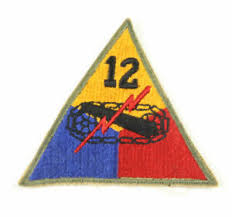
The 12th Armored Division, nicknamed the Hellcat Division, was one of the American armored divisions that distinguished themselves on the European front at the end of World War II through their fighting spirit, mobility, and role in liberating occupied territories. It perfectly exemplifies the effectiveness of American armored units in the war of movement in Western and Central Europe.
The division was activated on September 15, 1942, at Camp Campbell, Kentucky, and received intensive training in armored combat tactics, combining tanks, mechanized infantry, self-propelled artillery, and motorized reconnaissance. Its nickname, Hellcat, was given to it for its reputation for aggressiveness and speed during training maneuvers, qualities that would become its trademark on the battlefield.
After nearly two years of preparation, the 12th Armored Division landed in France in November 1944 and was quickly integrated into General George S. Patton's Third U.S. Army. Its initial missions consisted of securing lines of communication and supporting the advances of infantry units, but it was soon engaged in more intense combat. The division distinguished itself in the Lorraine region, where it participated in the recapture of important towns and secured vital roads for the American advance.
The real test for the division came during the Battle of the Bulge in the winter of 1944-1945. Although less directly involved in the fighting at Bastogne than other units, the 12th Armored Division was involved in counterattacks, covering fire, and pursuing the retreating enemy. It demonstrated its ability to combine mobility and firepower, using its armored vehicles to strike enemy positions quickly while protecting the flanks of Allied forces.
In early 1945, the division took part in the Allied offensive in Germany. It crossed the Saar and Rhine rivers, advancing rapidly through the west and center of the country. In this context, the 12th Armored Division played a crucial role in the liberation of many German and Austrian cities and contributed to the reduction of enemy pockets of resistance. It was also involved in the discovery and liberation of prison camps and concentration camps, a mission that would leave a lasting mark on the memory of its soldiers and on the history of the war.
In terms of service records, the division received campaign credits for Lorraine, the Ardennes-Alsace, the Rhineland, and Central Europe. Its effectiveness lay in its ability to combine the speed of its armored vehicles with the aggressiveness of its operations, while adapting to varied terrain and often difficult weather conditions. The 12th Armored Division ended the war in southern Germany and Austria, having contributed significantly to the final collapse of German forces.