

1st Army
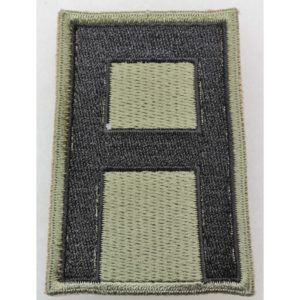
The First United States Army, or 1st Army, played a central role in the Allied effort in Europe during World War II, being one of the main American armies engaged on the Western Front. Its history during the war reflects the challenges of strategic planning, the complexity of combined Allied operations, and the evolution of the U.S. Army toward large-scale operations in a European theater.
The 1st Army was reactivated for World War II in 1943, led by General Omar N. Bradley, an officer renowned for his ability to combine careful planning with initiative in the field. It became the U.S. Army's lead force for the Normandy landings, responsible for coordinating American forces on the French coast during Operation Overlord.
On June 6, 1944, the 1st Army led the landings on Utah and Omaha beaches in Normandy. The first few hours were marked by fierce fighting, particularly at Omaha, where troops had to overcome powerful German defenses, steep cliffs, and beach obstacles. The success of this operation laid the groundwork for the opening of a second front in Western Europe and allowed the 1st Army to advance inland.
In the weeks following the landing, the 1st Army took part in the Battle of Normandy, facing experienced German troops and fortified positions. The campaign was long and costly, but it resulted in the breaking of German lines and the liberation of Paris at the end of August 1944. The army then engaged in the Lorraine campaign, pursuing the enemy across France and securing strategic points on the road to Germany.
In the winter of 1944, the 1st Army was directly involved in the Battle of the Bulge, the German offensive known as the Battle of the Ardennes. Although most of the resistance was provided by Patton's 3rd Army and units of the 101st Airborne, the 1st Army had to defend a large sector and react quickly to the German breakthrough, mobilizing reserves and coordinating counterattacks to contain the enemy advance and secure lines of communication.
In 1945, the 1st Army took part in the final offensive in Germany. It crossed the Saar and Rhine rivers and advanced towards the Rhineland, engaging numerous German cities and industrial centers. The army played a major role in reducing pockets of resistance, capturing prisoners, and securing key roads for the Allied advance. It finally reached central Europe, contributing to the surrender of German forces and the liberation of occupied territories, ending its active operations with the German surrender in May 1945.
In terms of service records, the 1st Army received campaign credits for Normandy, Lorraine, the Ardennes-Alsace, the Rhineland, and central Europe. Its success was based on the coordination of multiple army corps and combat divisions, the ability to integrate Allied forces, and the maintenance of a continuous effort on several fronts. It was also an example of the rise of the U.S. Army, capable of conducting large-scale operations and adapting to extremely complex tactical and logistical situations.