

3rd Army
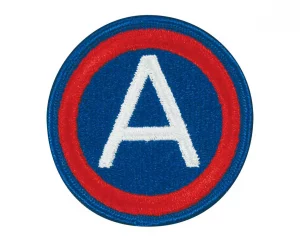
The Third United States Army, commanded by General George S. Patton, was activated for World War II in 1943 and deployed to the European theater in France in 1944. Its main role was to conduct large-scale mobile offensives as part of Allied operations on the Western Front, in coordination with the other armies of the First and Seventh U.S. Armies and with British and Canadian forces.
The Third Army entered action after the Normandy landings in August 1944, when it was redeployed from Brittany to exploit the breakthrough achieved in Operation Cobra. It participated in the liberation of Brittany, securing the ports of Saint-Malo and Brest, then in the rapid advance through northern and eastern France, crossing the Seine and Meuse rivers and advancing towards the Moselle and Lorraine. It took part in the fighting to reduce the German pockets around Metz and in the capture of the city of Nancy.
During the winter of 1944-1945, the Third Army was engaged in the Battle of the Bulge, conducting counterattacks to liberate Bastogne and regain ground lost to the German offensive. After the front stabilized, it resumed its offensive towards Germany, crossing the Saar and the Rhine in early 1945.
In 1945, the Third Army took part in operations in the Rhineland and the advance into central Germany. It reduced several pockets of resistance, captured cities and industrial centers, and contributed to the surrender of numerous German units. It continued its operations until Germany's surrender in May 1945, before taking on security and disarmament missions in occupied German territory.
The campaign credits awarded to the Third Army include Normandy, Northern France, Lorraine, Ardennes-Alsace, Rhineland, and Central Europe. The army coordinated the actions of numerous infantry and armored divisions, as well as specialized units, and participated in all major American offensives on the Western Front, from the exploitation of the breakthrough in Normandy to the end of operations in Germany.