

4th Armored Division
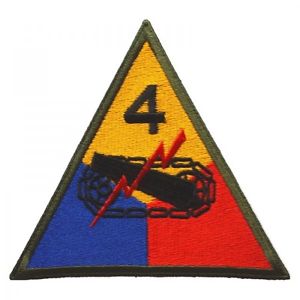
The U.S. Army's 4th Armored Division was activated before World War II and prepared for large-scale armored operations. It was deployed to the European theater in 1944, integrated into General George S. Patton's Third U.S. Army.
The division participated in operations after the Normandy landings, helping to exploit the breakthrough achieved during Operation Cobra in July 1944. It advanced rapidly through France, liberating towns and securing essential communication routes for the U.S. Army, particularly in the Normandy region, then across the Seine, Moselle, and Lorraine.
In the fall of 1944, the 4th Armored Division participated in the reduction of German positions in Lorraine and the advance toward the Rhine, operating in the Rhineland campaign and contributing to the capture of cities and fortified areas. During the Battle of the Bulge in December 1944, the division was engaged in counterattack and position recovery operations, helping to stabilize the front in the face of the German offensive.
In 1945, the division took part in the final offensive in Germany, crossing the Rhine and advancing through the Rhineland and central Germany. It participated in the capture of cities, the surrender of enemy forces, and the reduction of pockets of resistance until Germany's surrender in May 1945.
The campaign credits awarded to the 4th Armored Division include Normandy, Northern France, Lorraine, Ardennes-Alsace, Rhineland, and Central Europe. The division participated in all of the Third Army's major armored offensives on the Western Front, from the exploitation of the breakthrough in Normandy to the final operations in Germany.