

Within the dedicated space of the Reagan Conference Center, the Airborne Museum sets up temporary exhibitions that generally remain in place for one year, renewable for a second year as required.
Following the 2025 exhibition “Indochina: French Paratroopers from 1944 to 1954,” the museum will unveil “Comics Go to War” on May 14, 2026. This original exhibition will run through November 30, 2027.
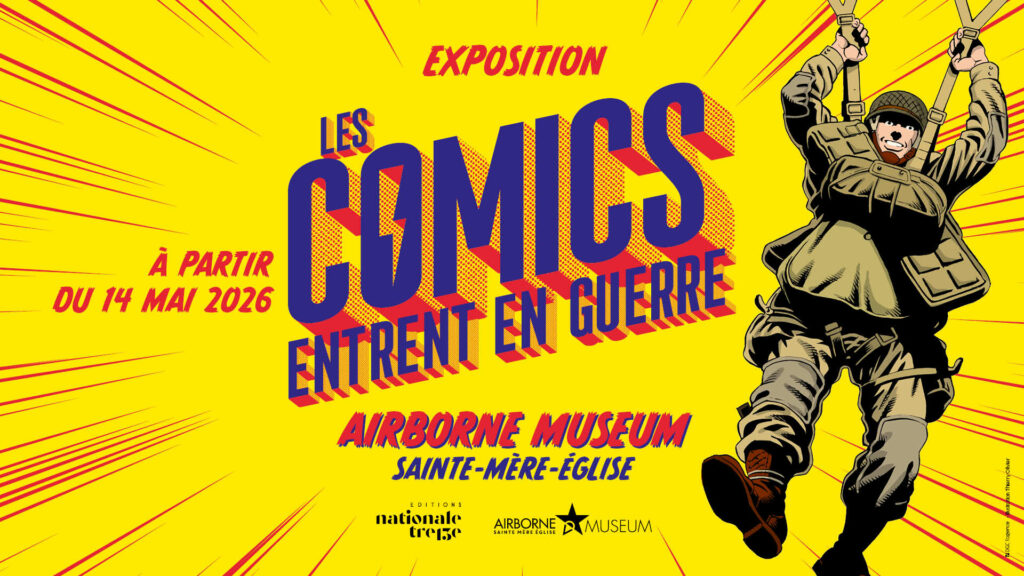
Immerse yourself in the history of comic books and their influence during World War II through three strikingly recreated period settings. Visit a comic book artist’s studio from the golden age of the 1930s and 1940s, then explore an American soldiers’ barracks plastered with posters of their favorite comics, and finally, go behind the scenes of the Airborne Museum’s new comic book about the life of John Steele, the bell tower paratrooper and Metropolis’s other Superman! A family-friendly tour set to the sounds of jazz, where drawings and reality blur and art becomes a political tool.This exhibition is a joint production in partnership with Editions Nationale 13 in Saint-Lô.
Admission to the exhibition is included in the museum entrance fee.
Exhibition Map
Room 1 — The Golden Age of the Newspaper Comic Strip
The first room traces the origins of the American comic book against the turbulent backdrop of the Great Depression and the rise of totalitarianism. It shows how, as early as the 1930s, the comic book established itself as a popular mass medium—accessible, inventive, and deeply rooted in its time. Driven by young creators, many of whom were immigrants, comics gave rise to a new heroic figure: the superhero, embodied first by Superman and then by Captain America. Long before the United States officially entered World War II, these characters took a stand against Nazism and helped turn comics into a tool for ideological engagement, at the intersection of entertainment, patriotism, and propaganda.
Room 2 — Comics Go to War
The second room explores the central role played by comics during World War II, as the United States entered the conflict. Here, superheroes became figures of national mobilization, symbolically engaged against the Axis powers, while conveying messages of the war effort to both civilians and soldiers. Distributed widely on the front lines, comics accompanied GIs into combat zones, where they boosted morale, facilitated the transmission of instructions, and fostered a shared culture within the U.S. military.
This room also shows how these stories—now prized as historical documents—reflect the values, fears, and stereotypes of wartime, before the genre’s decline following the Liberation and its subsequent reinvention in the context of the Cold War.
Room 3 — Behind the Scenes of the John Steele Comic Book
The third room establishes an original dialogue between the true story of John Steele, the paratrooper who remained suspended from the bell tower of Sainte-Mère-Église on the night of June 5–6, 1944, and the world of American superheroes. It highlights the surprising parallels between Steele and the world of Superman, particularly around the city of Metropolis, while tracing the genesis of the comic book dedicated to him by the Airborne Museum. This section takes visitors behind the scenes of the comic book’s creation: historical research, archival collection, writing, graphic design, narrative structure, and coloring. It shows how an iconic figure of the D-Day landings became the subject of an original work of remembrance, situated at the intersection of history, transmission, and visual storytelling.
Credits
Concept: Éditions Nationale 13
Text: Tom Graffin, Arnaud Digard, Jean Depelley
Sources & images: Éric Belloc / Airborne Museum, Jean Depelley, Arnaud Digard, Jean-Marc Lainé
Curators: Éric Belloc / Airborne Museum – Arnaud Digard / Nationale 13
Acknowledgments
The Airborne Museum and Éditions Nationale 13 would like to express their gratitude to the 82nd Airborne Division
Museum in Fort Bragg, North Carolina; the city of Metropolis, Illinois; Vicki Mayhall, who keeps the memory of John Steele alive; and John Steele’s family members for their kind contribution.